


Introduction
If you are learning English grammar, one of the most common questions is what is an adverb. Adverbs are an essential part of speech that add more detail and clarity to sentences. They help describe how, when, where, and to what extent an action happens.
Understanding what is an adverb is important for improving your writing, speaking, and overall communication skills. Whether you are a student, content writer, or English learner, mastering adverbs can make your language more expressive and precise.
In this comprehensive guide, we will explore the definition, types, examples, rules, and common mistakes related to adverbs.
What Is an Adverb? (Simple Definition)
An adverb is a word that modifies or describes:
- A verb
- An adjective
- Another adverb
- A whole sentence
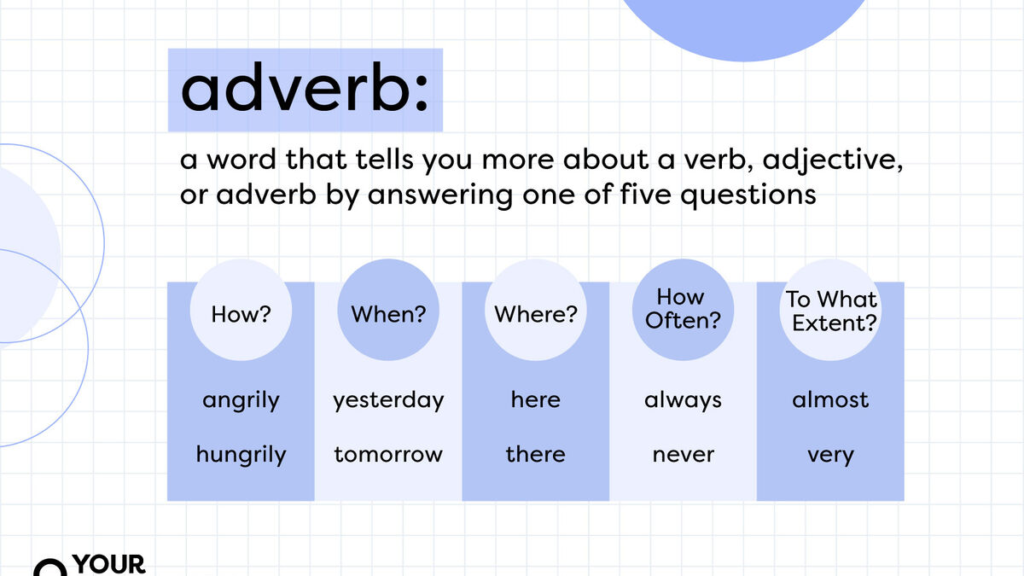
👉 In simple terms, if you are asking what is an adverb, the answer is:
An adverb tells us how, when, where, or how much something happens.
Examples to Understand What Is an Adverb

Here are some examples to clearly explain what is an adverb:
- She runs quickly. (How?)
- He arrived early. (When?)
- They looked everywhere. (Where?)
- The food is very delicious. (How much?)
In each sentence, the highlighted word is an adverb.
Types of Adverbs in English Grammar
Understanding types is key to mastering what is an adverb.
1. Adverbs of Manner
These describe how an action happens.
Examples:
- Quickly
- Slowly
- Carefully
👉 Sentence: She speaks softly.
2. Adverbs of Time
These tell us when something happens.
Examples:
- Now
- Yesterday
- Soon
👉 Sentence: We will leave tomorrow.
3. Adverbs of Place
These describe where an action occurs.
Examples:
- Here
- There
- Everywhere
👉 Sentence: He looked outside.
4. Adverbs of Frequency
These explain how often something happens.
Examples:
- Always
- Often
- Never
👉 Sentence: She always wakes up early.
5. Adverbs of Degree
These show how much or to what extent.
Examples:
- Very
- Too
- Quite
👉 Sentence: The movie is very interesting.
How to Identify What Is an Adverb in a Sentence


To identify what is an adverb, follow these steps:
- Look for words that describe actions
- Ask questions like:
- How?
- When?
- Where?
- How much?
- Check if the word modifies a verb, adjective, or another adverb
👉 Example:
She sings beautifully → “beautifully” answers how → it’s an adverb.
Formation of Adverbs
Most adverbs are formed by adding -ly to adjectives.
Examples:
- Quick → Quickly
- Happy → Happily
- Slow → Slowly
👉 However, not all adverbs follow this rule.
Irregular Adverbs:
- Good → Well
- Fast → Fast (same form)
- Hard → Hard
Position of Adverbs in Sentences
Placement is important when learning what is an adverb.
Common Positions:
- Beginning of sentence
👉 Quickly, she finished her work. - Middle of sentence
👉 She quickly finished her work. - End of sentence
👉 She finished her work quickly.
👉 The position may change emphasis.
Adverbs vs Adjectives
Many learners confuse adjectives with adverbs when studying what is an adverb.
Adjective:
Describes a noun
👉 She is a fast runner.
Adverb:
Describes a verb
👉 She runs fast.
👉 Key difference: Adverbs modify actions, adjectives modify things.
Why Adverbs Are Important in English


Understanding what is an adverb improves:
- Writing clarity
- Sentence detail
- Communication skills
- Grammar accuracy
Adverbs make sentences more informative and engaging.
Common Mistakes with Adverbs
When learning what is an adverb, avoid these mistakes:
1. Using Adjectives Instead of Adverbs
❌ She runs quick
✅ She runs quickly
2. Overusing Adverbs
Too many adverbs can weaken writing.
3. Incorrect Placement
Wrong position can confuse meaning
Examples of Adverbs in Daily Use
Here are practical examples of what is an adverb in everyday sentences:
- He speaks clearly.
- She works hard.
- They arrived late.
- I almost finished my homework.
Advanced Use of Adverbs
Once you understand what is an adverb, you can use them in advanced ways:
1. Modifying Adjectives
👉 Very happy
2. Modifying Other Adverbs
👉 Runs very quickly
3. Sentence Adverbs
👉 Fortunately, we arrived on time.
Tips to Master What Is an Adverb
- Practice daily with sentences
- Read books and articles
- Identify adverbs in conversations
- Use them in writing exercises
Consistency is key to mastering grammar.
Frequently Asked Questions
What is an adverb in simple words?
An adverb is a word that describes a verb, adjective, or another adverb.
How do you identify an adverb?
Ask how, when, where, or how much in a sentence
Are all adverbs ending in -ly?
No, some adverbs do not end in -ly.
Can a sentence have more than one adverb?
Yes, multiple adverbs can be used in a sentence.
Conclusion
Now you clearly understand what is an adverb and how it works in English grammar. Adverbs play a vital role in making sentences more descriptive and meaningful.
By learning their types, usage, and rules, you can improve both your writing and speaking skills. Keep practicing, and soon you will be able to use adverbs naturally and effectively.
