


Introduction
The Jennifer Hegseth Pentagon role has attracted unusual attention because it sits in an uncomfortable space between private family support and public government business. Jennifer Hegseth, formerly Jennifer Rauchet, is the wife of U.S. Defense Secretary Pete Hegseth. Unlike her husband, she does not hold a formal position at the Department of Defense, yet reports have described her as a frequent presence around his work and an influential member of his inner circle.
That distinction is at the heart of the controversy. A cabinet secretary can naturally seek advice from a spouse, and political spouses have long played informal roles behind the scenes. What has made Jennifer Hegseth’s situation different is the extent of the involvement reported by journalists and former officials: attendance at official meetings, participation in communications, involvement in media strategy and, most controversially, inclusion in a Signal group where sensitive information about a U.S. military operation was discussed.
Understanding her Pentagon role therefore requires separating what is officially documented from what has been reported about her influence. She is not the secretary of defense, a Pentagon employee, or a publicly established senior defense official. Her significance comes instead from her proximity to the person who occupies one of the most powerful national-security positions in the United States.
1. Who Is Jennifer Hegseth and Why Is She Connected to the Pentagon?
Jennifer Hegseth, whose maiden and professional name was Jennifer Rauchet, worked as a television producer before her marriage to Pete Hegseth. She and Hegseth met while working at Fox News, where she was a producer and he was a television personality. Her professional background is significant because it helps explain why she has been associated with communications, presentation and media strategy around her husband’s public activities.
Her connection to the Pentagon became much more prominent after Pete Hegseth became secretary of defense in 2025. Unlike a political appointee or senior military officer, Jennifer did not receive a Senate-confirmed position or a formal departmental title. Reporting has consistently described her as an unofficial presence rather than a government official. The Washington Post, for example, reported that she had no official government role while nevertheless becoming unusually active in Pentagon affairs.
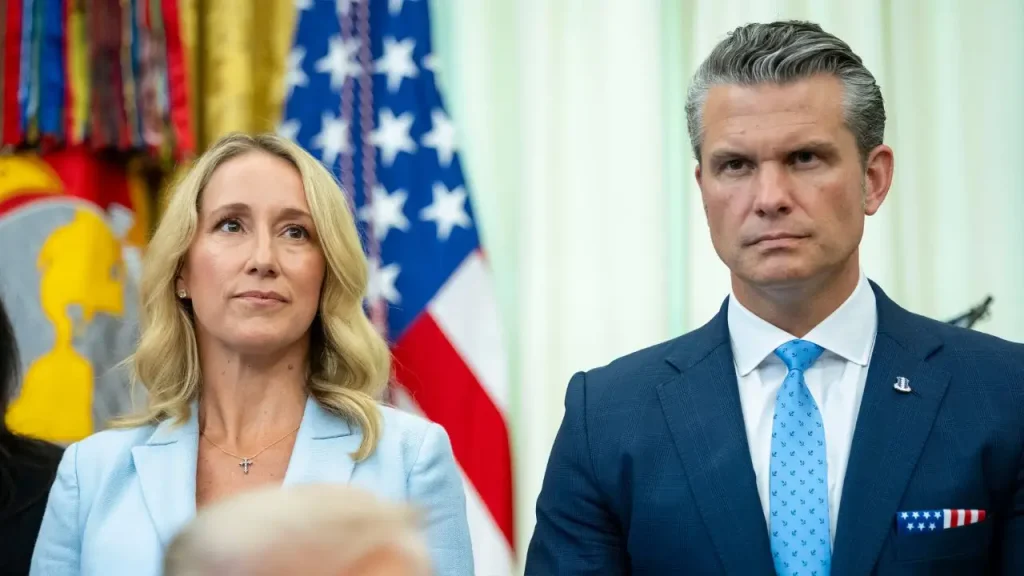
That difference matters. Government departments operate through formal chains of authority, written responsibilities and security procedures. A spouse may advise a cabinet secretary privately, but that does not automatically give the spouse authority to direct employees, participate in sensitive meetings or receive government information. The controversy surrounding Jennifer Hegseth has largely emerged because reports have suggested that the boundary between private adviser and public-facing participant became unusually blurred.
Her professional experience also gives context to reports about her involvement in Pete Hegseth’s public image. Several accounts have described her as helping with appearances, messaging and media-related matters. The Independent reported that she was alleged to have acted as a go-between with Pentagon staff and helped shape aspects of the secretary’s public presentation.
2. What Is Jennifer Hegseth’s Pentagon Role in Practice?
The simplest answer is that Jennifer Hegseth does not have a formal Pentagon job. She has not been publicly identified as holding an official Defense Department position comparable to an assistant secretary, adviser, chief of staff or communications official. This point is essential because descriptions of her as a “Pentagon official” can create a misleading impression about her legal or administrative authority.
Her reported role is better described as informal influence around the secretary of defense. News reports have portrayed her as someone who stays close to Pete Hegseth during his official schedule, sometimes sitting in meetings and helping him prepare for public engagements. A 2026 report from the Guardian said Pentagon insiders were surprised by her continued presence at official meetings, where she reportedly sat toward the back of the room.
| Detail | Information |
|---|---|
| Focus Keyword | jennifer hegseth pentagon role |
| Jennifer Hegseth | Wife of U.S. Defense Secretary Pete Hegseth |
| Former Name | Jennifer Rauchet |
| Official Pentagon Position | No formal Department of Defense position |
| Professional Background | Former television producer |
| Fox News Connection | Worked at Fox News, where she met Pete Hegseth |
| Reported Pentagon Role | Informal adviser and close personal influence around Pete Hegseth |
| Meeting Attendance | Reportedly attended some official meetings involving her husband |
| Media Involvement | Reportedly involved in aspects of Pete Hegseth’s media preparation and public presentation |
| Signal Controversy | Reportedly included in a separate Signal group involving Pete Hegseth and members of his personal circle |
| Security Clearance | Public reporting has raised questions about whether she held or sought a clearance |
| Main Controversy | The boundary between private family influence and official Defense Department business |
| Formal Decision-Making Authority | None publicly established |
| Why It Matters | Her proximity to the defense secretary has raised questions about access, accountability and national-security protocols |
That kind of access can be influential even when no formal authority exists. A person does not need a government title to affect decisions if the secretary routinely seeks that person’s advice. In large organizations, access to the leader can itself become a form of influence. Employees may also pay close attention to the opinions of people who are known to have the leader’s trust.
Reports have gone further, describing Jennifer as one of Hegseth’s closest advisers. A recent report from The Daily Beast cited current and former officials and people close to her who described her as helping prepare her husband for appearances, participating in staff interviews and contributing ideas about Pentagon communications. Those claims illustrate why the phrase “unofficial role” has become central to discussions about her presence.
Still, it is important not to confuse reported influence with formal authority. There is no evidence that Jennifer Hegseth became a cabinet official through her relationship with the secretary. Her role, as publicly described, has remained informal, personal and dependent on her access to her husband.
3. Why Her Attendance at Pentagon Meetings Became Controversial
One of the biggest sources of controversy has been Jennifer Hegseth’s reported attendance at meetings involving senior government and foreign officials. CNN reported that she had been present at several meetings involving her husband, including a high-level meeting with British Defense Secretary John Healey. Pentagon officials said she was not present for classified or sensitive discussions.
That distinction is important because attendance itself does not prove that a person received classified information. A meeting may contain both routine and sensitive portions, and officials can exclude non-cleared participants when restricted information is discussed. Pentagon spokespersons have specifically pushed back against suggestions that Jennifer attended meetings in which classified or sensitive material was discussed.
Nevertheless, the optics raised questions because the secretary of defense routinely deals with information that can affect military operations, alliances and national security. Foreign defense officials may also expect meetings at that level to involve only people with clear official responsibilities. Even if no classified information is disclosed, the presence of an unofficial participant can create uncertainty about protocol.
The issue became more serious when Jennifer was reportedly included in a separate Signal group involving her husband and members of his personal circle. According to ABC News, the group included Jennifer, Pete Hegseth’s brother Phil Hegseth and his personal lawyer Tim Parlatore. The group was separate from the Signal chat that accidentally included journalist Jeffrey Goldberg and became the center of the first major controversy over the Yemen operation.
Reports said information about the March 2025 U.S. military strikes against the Houthis in Yemen was shared in the second group. The episode intensified scrutiny because Jennifer did not work for the Defense Department. CNN reported that it was unclear whether she had a security clearance and that she had reportedly submitted paperwork seeking one.
4. The Security and Ethics Questions Surrounding Her Role
The central question is not simply whether Jennifer Hegseth had good intentions. It is whether an unofficial participant should have access to discussions involving national-security information. Defense organizations depend on strict rules governing who receives sensitive information, why they receive it and how that information is protected.
The Signal controversy brought that question into sharp focus. The Washington Post later reported that Jennifer had no official Pentagon role, while the broader investigation into the handling of messages examined whether information shared in Hegseth-related communications should have been classified.
There is also an important distinction between security clearance and need to know. Having a clearance does not automatically give an individual access to every piece of classified information. Access generally depends on both authorization and a legitimate need to receive the information. That principle exists precisely because national-security information can cause serious harm if distributed beyond the appropriate circle.
Jennifer’s reported participation therefore raised questions beyond the technical issue of whether she possessed a clearance. Critics questioned why a person without an official Defense Department position would need access to operational discussions at all. Supporters of Hegseth, meanwhile, have argued that the criticism has exaggerated her involvement and portrayed her as a trusted partner rather than someone exercising governmental authority.
The Pentagon has defended her in public statements. According to CNN reporting, Pentagon officials said she had never attended a meeting where sensitive or classified information was discussed. That position is significant because it represents the department’s stated interpretation of her activities, while reports from other sources have focused on the unusual nature of her access.
The ethical debate is therefore broader than one individual. It concerns how much informal influence should surround a cabinet secretary, where professional boundaries should be drawn, and how government institutions protect information when leaders rely heavily on trusted personal advisers.
5. Jennifer Hegseth’s Media Background and Influence on Pete Hegseth’s Public Image
Jennifer’s previous career in television production is another major part of the story. Before becoming closely associated with the Pentagon, she worked behind the scenes in television. That experience is relevant because Pete Hegseth’s public profile has always been strongly connected to media appearances, particularly his years at Fox News.
The Defense Department under Hegseth has placed considerable emphasis on public communication, and reports have described Jennifer as having an interest in how her husband appears publicly. CBS News reported that Jennifer, along with Pentagon personnel, approved improvements to a green-room-style space used for senior leaders and VIPs before media engagements.

That may seem like a relatively minor matter compared with military strategy, but it illustrates why her professional background has become relevant. A former television producer can bring practical knowledge about interviews, messaging, presentation and production. For a cabinet secretary who regularly communicates with television audiences, that expertise could be personally valuable.
The controversy begins when personal advice appears to overlap with departmental decision-making. If a spouse privately tells a cabinet secretary how to prepare for an interview, that is fundamentally different from directing government employees or influencing official departmental messaging. Reports have alleged that Jennifer’s involvement sometimes extended beyond private advice, which is why her role has received sustained attention.
There is another dimension to consider: trust. Pete Hegseth has publicly credited his wife and his faith as important influences in his life. A close personal relationship can naturally lead a cabinet secretary to rely heavily on a spouse during a demanding and politically contentious appointment. That does not automatically make the arrangement improper, but it can become problematic if informal influence begins replacing established professional structures.
For the Pentagon, maintaining clear lines between political leadership, professional staff and family members is especially important. Defense decisions involve military personnel, intelligence, diplomacy and potentially life-or-death consequences. The closer an unofficial adviser gets to those decisions, the more questions arise about accountability.
Conclusion
The Jennifer Hegseth Pentagon role is unusual precisely because it is not a formal role. Jennifer Hegseth is not publicly identified as a Defense Department employee or senior government official. Instead, her significance comes from her close relationship with Defense Secretary Pete Hegseth and the unusually visible access she has reportedly enjoyed around his official activities.
Her presence has generated debate over meetings, communications, media strategy and national-security information. Reports have described her attending official gatherings, advising her husband and participating in communications involving his inner circle, while Pentagon officials have disputed some of the more serious allegations and maintained that she was not present for classified or sensitive discussions.
Ultimately, the issue is less about whether a cabinet secretary can listen to his spouse and more about where institutional boundaries should be drawn. Personal trust is understandable in an intense government position, but national-security organizations also require formal accountability, clearly defined responsibilities and disciplined control over sensitive information. Jennifer Hegseth’s unusual proximity to the Pentagon leadership has made those principles part of a much larger conversation about how power operates behind the official titles.
FAQs About Jennifer Hegseth’s Pentagon Role
1. Does Jennifer Hegseth have an official job at the Pentagon?
No. Public reporting has consistently described Jennifer Hegseth as having no formal position with the Department of Defense. Her involvement has instead been characterized as unofficial and connected to her role as Pete Hegseth’s wife and close adviser.
2. Who is Jennifer Hegseth?
Jennifer Hegseth, formerly Jennifer Rauchet, is the wife of Defense Secretary Pete Hegseth. She previously worked as a television producer at Fox News, where she met Hegseth.
3. Why is Jennifer Hegseth associated with the Pentagon?
She became associated with the Pentagon because of her husband’s position as secretary of defense. Reports have described her as frequently accompanying him and participating in aspects of his professional and public life.
4. Did Jennifer Hegseth attend Pentagon meetings?
Multiple news organizations have reported that she attended some meetings involving her husband and other officials. Pentagon representatives have said she was not present during discussions involving classified or sensitive information.
5. Was Jennifer Hegseth part of a Signal chat?
Yes. Reports said she was included in a separate Signal group involving Pete Hegseth and members of his personal circle. The group reportedly contained information concerning U.S. military operations in Yemen.
6. Does Jennifer Hegseth have a security clearance?
Public reporting has not established that she holds a security clearance. CNN reported in 2025 that she had reportedly submitted paperwork to seek one, while the Pentagon declined to comment on individual clearance matters.
7. What was Jennifer Hegseth’s career before the Pentagon controversy?
She worked as a television producer, including at Fox News. Her production background has become relevant because of reports about her involvement in Pete Hegseth’s media appearances and public presentation.
8. Does Jennifer Hegseth make Pentagon decisions?
There is no public evidence that she possesses formal authority to make Defense Department decisions. Reports have instead focused on her alleged informal influence and proximity to the secretary of defense.
9. Why has her Pentagon presence attracted criticism?
Criticism has centered on the boundary between private family advice and official government business. Her reported presence at meetings and participation in communications involving sensitive military matters raised questions about access, protocol and accountability.
10. Is Jennifer Hegseth a Pentagon official?
No. She should not be described as a Pentagon official simply because she has been seen around the department or has reportedly advised her husband. Public reporting identifies her as a private citizen without a formal Defense Department position
