

Introduction
The bitcoin price has always been a subject of intense attention because few financial assets can move as quickly, dramatically, or unpredictably as Bitcoin. A change of several thousand dollars in a single day is not unusual, and major economic announcements, institutional buying, regulatory developments, investor sentiment, or changes in liquidity can rapidly reshape the market.
As of August 20, 2026, Bitcoin has been experiencing a sharp rebound. Market reports put BTC above the $70,000 level during the day, with prices reaching roughly $71,000–$72,000 at points during the rally. The move came after a period of weakness and was accompanied by stronger institutional demand and significant short-position liquidations.
That makes the current bitcoin price especially interesting. Bitcoin is still well below its October 2025 record high of about $126,198, according to market data, but its latest recovery demonstrates how quickly sentiment can change.
Understanding Bitcoin therefore requires more than looking at one number on a chart. The price reflects a complicated interaction between supply, demand, liquidity, macroeconomic conditions, investor psychology, regulation, technology, and institutional participation. This guide examines those factors and explains how readers can interpret Bitcoin’s price movements more intelligently.
1. What Determines the Bitcoin Price?
Bitcoin’s price is ultimately determined by supply and demand. Unlike a traditional currency, Bitcoin does not have a central bank that sets an official value or uses monetary policy to target a particular exchange rate. Buyers and sellers meet across cryptocurrency markets, and the resulting transactions continuously establish the market price.
The supply side is unusual because Bitcoin’s monetary policy is built into its protocol. The maximum supply is limited to 21 million BTC, while new coins are introduced through the mining process. CoinMarketCap currently lists Bitcoin’s maximum supply at 21 million and its circulating supply at roughly 20.07 million BTC. This scarcity is one of the central arguments behind Bitcoin’s long-term value proposition.

Demand, however, can change dramatically. When investors become more confident in Bitcoin, they may buy aggressively, pushing the price higher. When sentiment turns negative, selling can accelerate just as quickly. This is why Bitcoin can rise much faster than many traditional assets during periods of strong demand, while also experiencing severe corrections when buyers disappear.
The Role of Market Liquidity
Liquidity is another major factor. A highly liquid market can absorb large transactions with relatively less price disruption, while thinner liquidity can make price movements much more violent. Large institutional orders, leveraged trading, and sudden changes in market participation can therefore produce significant short-term swings.
| Element | Details |
|---|---|
| Primary Keyword | bitcoin price |
| SEO Title | Bitcoin Price: Current Trends, Key Drivers, History, and Future Outlook |
| Meta Title | Bitcoin Price: Current Value, Trends & Market Outlook |
| Meta Description | Bitcoin price explained with current market trends, historical performance, major price drivers, risks, and what investors should watch. |
| Slug | bitcoin-price |
| Category | Business |
| Article Type | Finance / Cryptocurrency |
| Main Topic | Bitcoin price, market movements, trends, and influencing factors |
| Target Audience | Cryptocurrency investors, traders, beginners, and financial readers |
| Main Sections | 5 detailed headings + conclusion + 10 FAQs |
| Key Factors Covered | Supply and demand, market liquidity, institutional investment, regulation, macroeconomics, leverage, investor psychology |
| Bitcoin Supply | Maximum supply of 21 million BTC |
| Historical High Discussed | Approximately $126,198 in October 2025 |
| Current Trend Discussed | Bitcoin’s August 2026 recovery above $70,000 |
| Risk Level | High volatility; significant gains and losses are possible |
| Recommended Category | Business |
| S |
Bitcoin also trades continuously, unlike traditional stock markets that close each day. Prices can move during weekends, holidays, overnight sessions, and major global news events. For investors, this means the bitcoin price can react to information at almost any hour.
2. Bitcoin Price History and Major Market Cycles
Bitcoin’s history provides an important lesson: enormous gains have repeatedly been accompanied by enormous declines. The cryptocurrency has experienced several dramatic bull and bear markets since its early years, and each cycle has attracted new investors while testing the patience of existing holders.
Historical data shows how extreme those movements can be. Bitcoin reached a record high close of approximately $124,753 on October 6, 2025, while other market feeds recorded an intraday high near $126,200. The cryptocurrency subsequently entered a major decline, with 2026 bringing periods of significant weakness before the August recovery.
The historical pattern should not be interpreted as a guaranteed cycle. Markets do not repeat perfectly, and Bitcoin’s structure has changed considerably as institutional participation has increased. Nevertheless, previous cycles demonstrate that investors who buy after a period of extraordinary optimism can face substantial drawdowns.
From Speculative Asset to Institutional Market
Bitcoin was once primarily associated with technology enthusiasts and individual traders. Its market has since developed into a much larger financial ecosystem involving exchanges, custodians, asset managers, derivatives markets, mining companies, and exchange-traded products.
That evolution can influence price behavior. Institutional investors may bring larger pools of capital and longer investment horizons, but they can also introduce new forms of market sensitivity. Bitcoin can increasingly react to interest-rate expectations, bond yields, equity-market conditions, portfolio allocation decisions, and broader financial liquidity.
The 2026 market illustrates this changing relationship. Recent reports attributed part of Bitcoin’s August rally to falling long-term Treasury yields and improving financial conditions, while separate reports highlighted renewed institutional inflows.
3. Why the Bitcoin Price Can Change So Quickly
Bitcoin’s volatility is one of its defining characteristics. A stock may move several percentage points in a day and attract considerable attention; Bitcoin can make comparable moves in much shorter periods. The reason is not simply speculation. Several market mechanisms reinforce one another.
Leverage is particularly important. Cryptocurrency exchanges allow traders to take positions much larger than the amount of capital they actually hold. When prices move against highly leveraged traders, exchanges can automatically close their positions. Those forced liquidations can create additional buying or selling pressure.
The August 20, 2026 rally provides a clear example. One market report estimated that more than $3.13 billion in crypto short positions were liquidated during the move, including about $1.77 billion in Bitcoin shorts. When large numbers of traders are positioned for falling prices and the market suddenly rises, forced buying can accelerate the rally.
Investor Psychology Matters
Human behavior is another major ingredient. Bitcoin is traded by people with very different objectives. Some investors hold for years because they believe Bitcoin will become an important store of value. Others trade movements lasting minutes or hours. Some institutions use Bitcoin as part of a diversified portfolio, while others use derivatives to hedge exposure.
These groups can react very differently to the same event.
A sharp price increase may attract momentum traders who fear missing the move. That additional demand can push the price higher. Eventually, however, some investors take profits, and a small decline can trigger panic among highly leveraged traders. The result can be a rapid reversal.
This is why headlines about Bitcoin should be treated carefully. A single day’s movement does not necessarily establish a new long-term trend. Investors need to distinguish between a short-term trading event and a fundamental change in the market.
4. The Biggest Factors Influencing Bitcoin Price in 2026
Several forces are particularly relevant to Bitcoin’s market direction in 2026. The first is institutional demand. Spot Bitcoin exchange-traded products have made it easier for traditional investors to gain exposure without directly managing cryptocurrency wallets or private keys.
Recent market reporting showed substantial Bitcoin ETF inflows during the August rally, with one report citing approximately $517 million of inflows in a single day and around $1 billion for the week. Sustained institutional demand can potentially provide a stronger base for the market, although flows can reverse and should never be treated as a guaranteed indicator of future prices.
Macroeconomic policy is another important influence. Bitcoin does not exist separately from the global financial system. Interest rates, bond yields, currency movements, liquidity conditions, and investor appetite for risk can all affect the amount of capital flowing into speculative and alternative assets.
The August 2026 rally demonstrates this connection. Reports linked Bitcoin’s move above $70,000 partly to a U.S. Treasury decision involving increased long-term bond buybacks, which contributed to lower long-term yields and improved financial conditions.
Regulation Can Move Markets
Regulation is equally significant. Clear rules can make financial institutions more comfortable entering the cryptocurrency market, while uncertainty can discourage investment or increase risk premiums.
On August 20, 2026, Bitcoin and other cryptocurrency-related assets received a boost after U.S. President Donald Trump urged Congress to advance the Clarity Act, legislation intended to establish clearer legal definitions and regulatory responsibilities for digital assets.
Regulation can affect Bitcoin in both directions. Favorable rules may increase institutional participation, while restrictive policies can reduce liquidity or create uncertainty. Investors should therefore watch major regulatory developments rather than assuming that every political announcement will have a lasting effect on price.
5. How to Read the Bitcoin Price Without Getting Misled
The easiest way to misunderstand Bitcoin is to focus exclusively on its current price. A price such as $70,000 sounds enormous when viewed by itself, but the number has little meaning without context.
For example, Bitcoin trading around $70,000 does not automatically mean it is expensive or cheap. Investors should consider the distance from the previous record, market capitalization, trading volume, realized market activity, institutional flows, broader economic conditions, and the time horizon being considered.
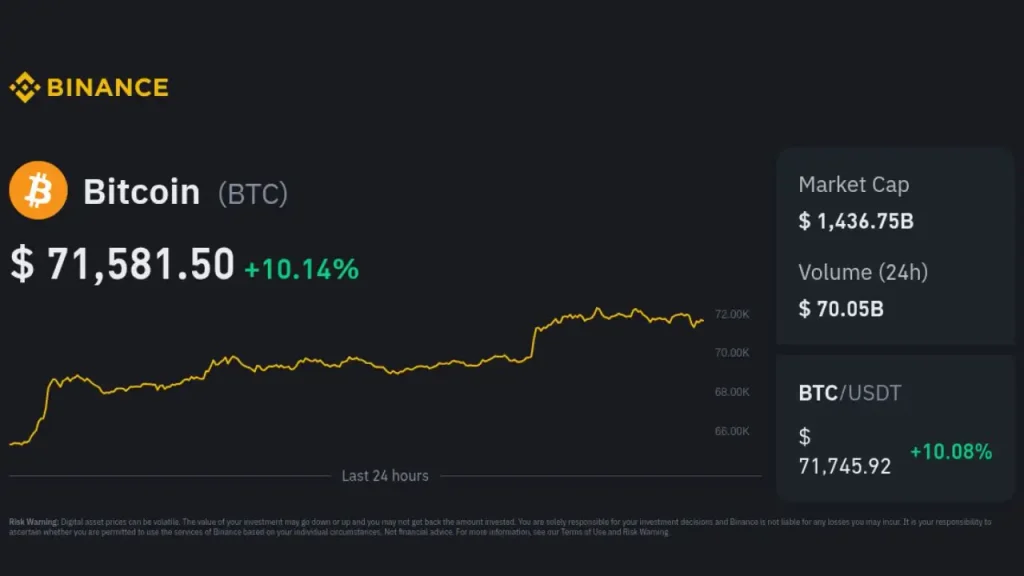
Bitcoin’s October 2025 record is a useful reference point. With the asset previously reaching roughly $126,200, a price around $70,000 represents a substantial decline from that peak even though the absolute number remains high.
Useful Metrics to Watch
One useful measure is trading volume. Rising prices accompanied by strong volume can indicate broad participation, although volume alone does not prove that a rally will continue. Another useful indicator is market liquidity, particularly when large amounts of leverage are present.
Investors can also monitor Bitcoin’s relationship with other assets. At certain times, BTC behaves like a risk asset and moves alongside technology stocks. At other times, investors treat it more like a scarce alternative asset. Its behavior can shift depending on market conditions.
Another important consideration is volatility. Someone who cannot tolerate a 20% or 30% decline should think carefully before taking a large Bitcoin position. Historical data contains numerous examples of severe drawdowns, including periods when Bitcoin lost most of its value from previous peaks. One historical analysis estimates that Bitcoin’s largest drawdowns have exceeded 80%.
For that reason, a sensible approach is to determine how much risk can actually be tolerated before purchasing Bitcoin rather than making the decision based on excitement after a major rally.
Conclusion
The bitcoin price is shaped by far more than speculation. Supply constraints, changing demand, institutional participation, market liquidity, leverage, regulation, macroeconomic conditions, and investor psychology all contribute to Bitcoin’s constantly changing valuation.
The market’s latest move in August 2026 is a useful reminder of Bitcoin’s character. After significant weakness earlier in the year, BTC rapidly climbed back above $70,000, helped by stronger risk appetite, institutional flows, regulatory optimism, and market positioning.
Yet a rally does not eliminate risk. Bitcoin remains capable of substantial corrections, and its distance from the previous record does not guarantee that a new all-time high is imminent. Investors are better served by understanding the forces behind the market than by attempting to predict every daily movement.
Bitcoin may continue becoming more integrated with traditional finance, but its defining characteristic remains volatility. Anyone following its price should therefore look beyond the headline number and consider the broader market environment, their investment horizon, and their ability to withstand significant losses.
Frequently Asked Questions
1. What is the current bitcoin price?
The bitcoin price changes continuously because BTC trades around the clock. On August 20, 2026, market reports showed Bitcoin moving above $70,000 and reaching roughly $71,000–$72,000 during the day’s rally.
2. Why does the bitcoin price change so much?
Bitcoin is highly volatile because its market is global, operates continuously, and contains significant speculative and leveraged activity. Changes in liquidity, investor sentiment, economic conditions, regulation, and large buying or selling orders can produce rapid movements.
3. What was Bitcoin’s highest price?
Bitcoin reached an all-time high around October 2025. CoinMarketCap reports an all-time high of approximately $126,198.07 on October 6, 2025, while other market datasets show slightly different figures depending on the exchange and methodology.
4. Why is Bitcoin limited to 21 million coins?
Bitcoin’s protocol was designed with a maximum supply of 21 million BTC. The limited supply is a fundamental part of Bitcoin’s monetary design and is one reason investors often compare it with scarce assets.
5. Does Bitcoin’s limited supply guarantee a higher price?
No. Scarcity alone does not guarantee appreciation. Bitcoin still requires sufficient demand to support a higher market value. If demand falls substantially, the price can decline even though the maximum supply remains fixed.
6. What makes Bitcoin rise?
Bitcoin can rise when demand increases relative to available supply. Institutional buying, improving market liquidity, favorable regulation, lower yields, positive sentiment, increased adoption, and short liquidations can all contribute to upward price movements.
7. Can Bitcoin fall sharply after a major rally?
Yes. Bitcoin has repeatedly experienced significant corrections after powerful rallies. Leverage can make these declines particularly rapid because falling prices can trigger forced liquidations among traders who borrowed money to establish positions.
8. Is Bitcoin a good investment?
There is no universal answer. Bitcoin can provide substantial upside potential, but it also carries significant volatility and the possibility of large losses. Whether it is appropriate depends on an individual’s financial circumstances, risk tolerance, investment horizon, and overall portfolio.
9. What factors should investors watch when tracking Bitcoin price?
Useful factors include institutional flows, trading volume, liquidity, interest rates, Treasury yields, regulatory developments, derivatives positioning, broader market sentiment, and major changes in Bitcoin’s supply and demand dynamics.
10. Will Bitcoin reach a new all-time high?
Nobody can reliably guarantee when Bitcoin will reach another record. Forecasts can be useful for understanding different scenarios, but they should not be treated as certainties. Bitcoin’s history shows that both extremely strong rallies and deep corrections are possible.
